Over the past two years, the Ontario government has waged a battle against accountability, transparency, the rule of law, and human dignity. We’re rallying to call out the government on its anti-democratic agenda and to inspire people to mobilize against this unprecedented government overreach.
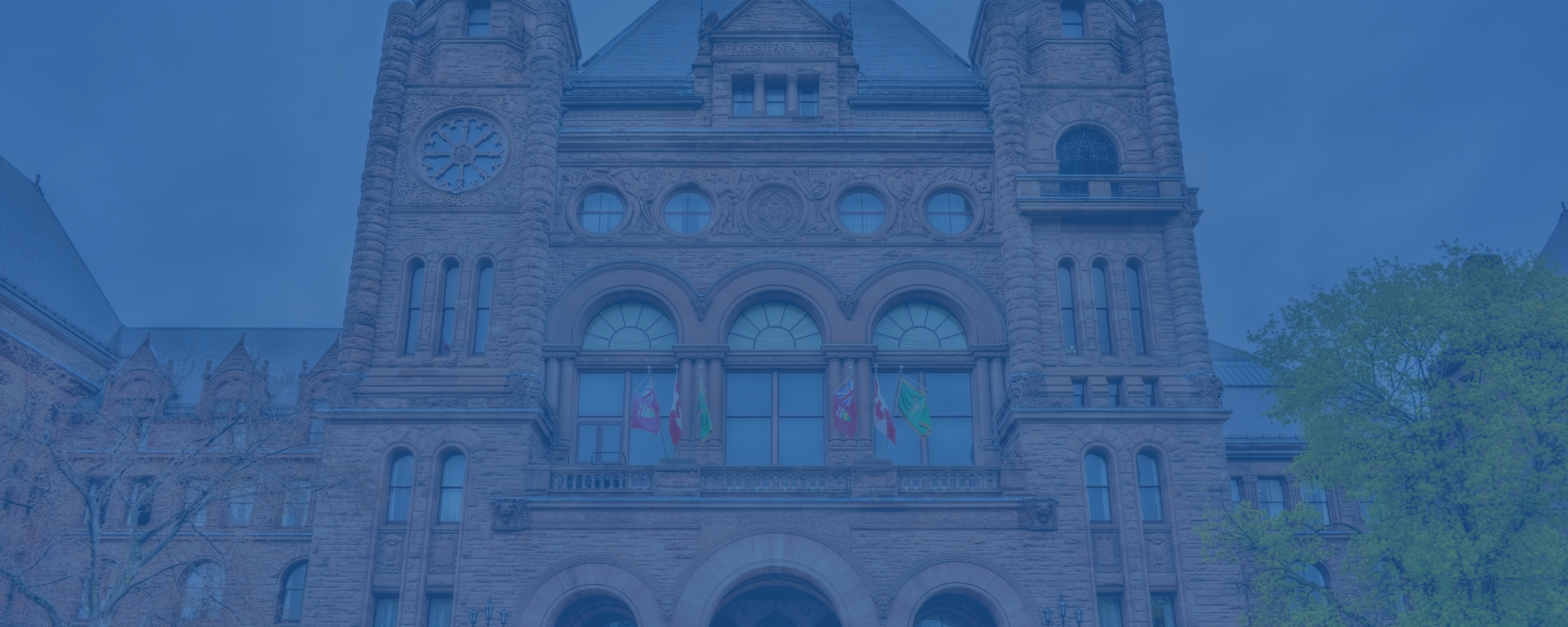
Join us at Queen's Park to challenge democratic erosion in Ontario.
Thursday, November 5, 2026 · 12:00 to 1:00 PM · Queen's Park, Toronto
Register here
Registration is purely optional for our planning purposes. Everyone is welcome to attend.
What we're rallying about
Threats to government transparency and accountability
In April, Ontario rewrote its freedom of information law to exclude records held by the Premier’s office, ministers, parliamentary assistants and their staff. The exclusion was made retroactive to 1988, meaning that it threatens some outstanding requests that the government has yet to respond to – including hotly contested records about the ongoing Greenbelt and Skills Development Fund scandals. The bill bypassed the committee stage, so it became law without the public scrutiny a change like this would normally face.
Freedom of information laws exist so that people know how their government is serving them and can cast an informed ballot at the next election. Journalists use it, and so do researchers, oversight bodies, community organizations, lawyers, and people trying to understand a decision that affected them directly. Closing it off at the top allows this and future governments to dodge public accountability for poor governance and flawed decision-making.
SPEAKER:
Brent Jolly
President, Canadian Association of Journalists
Canada’s largest professional organization for journalists has sounded the alarm on how the recent changes to Ontario’s freedom of information legislation limit investigative journalists’ ability to report on issues of public interest.
Threats to the rule of law
The Special Economic Zones Act lets Cabinet designate areas of the province as “special economic zones,” name certain companies as “trusted proponents,” and certain developments as “designated projects,” and then exempt them from provincial laws and municipal bylaws that would otherwise apply. None of those three terms are defined in the Act. The criteria are left to Cabinet, so the government sets its own standard and has the ability to change it.
The rule of law means the same rules apply to everyone. Allowing Cabinet to create lawless zones behind closed doors, where handpicked corporations are exempt from ordinary laws, is outrageously anti-democratic.
SPEAKER:
Julia Croome
Director of Litigation Practice, Ecojustice
Ecojustice is Canada’s largest environmental law charity. It acts as counsel on the constitutional challenge to Ontario’s Special Economic Zones Act.
Threats to human dignity
Ontario has spent public money and passed laws criminalizing people living in encampments, expanding jail capacity and tightening bail, promoted under the semblance of a safer province.
These measures treat poverty and homelessness as a crime. Having nowhere to live is not a crime. The province’s response to criminalize unhoused people rather than investing in housing and health care will not solve the homelessness crisis. These measures may move homelessness out of public view, which spares the government from having to answer for a crisis its own policies helped create.
SPEAKER:
Bill Sinclair
Chief Executive Officer, The Neighbourhood Group Community Services
The NGCS is a social agency serving more than 40,000 low-income people and families in 30 locations across Toronto.
Government overreach
Since 2025, eight locally elected school boards have been placed under provincial supervision. Elected trustees, including student trustees, have been stripped of their voting power and replaced by provincially appointed supervisors. Together those boards serve roughly a third of Ontario’s publicly funded students. Bill 33 takes governance over school boards out of local communities and centralizes this power in the hands of the government.
School board elections are, for many people, the level of democracy closest to their daily lives. Removing the elected layer removes the ability of parents, students and communities to be heard by someone who directly answers to them.
SPEAKER:
Martha Hradowy
President, Ontario Secondary School Teachers’ Federation
The OSSTF represents more than 60,000 education workers across Ontario. Its members experience firsthand the dire effects of the government’s takeover of school boards.
Organized by
The Canadian Civil Liberties Association, with remarks from Harini Sivalingam, Director of Equality and Shakir Rahim, Director of Criminal Justice.