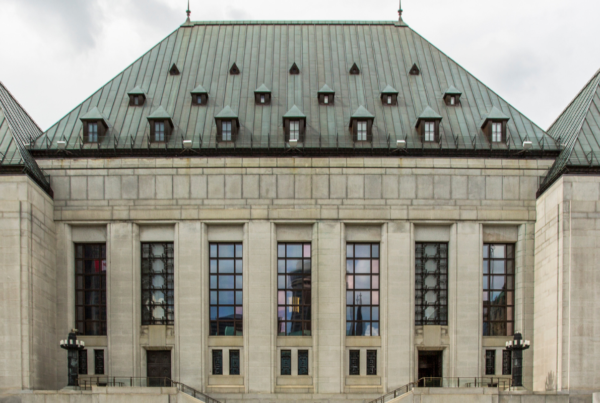

The CCLA will appear before the Supreme Court of Canada today as an intervener in Diggs v. AG (Nova Scotia).
This appeal is about whether a court can consider a habeas corpus application from a prisoner who experiences solitary confinement because of operational or policy decisions that also affect other prisoners. Habeas is a legal mechanism for a person deprived of their liberty by the state to challenge whether that deprivation is legal. An example of a situation this case concerns is where a prisoner endures solitary confinement because there are not enough staff to properly run a prison. A prisoner can already use habeas to challenge a decision specific to them that puts them in more restrictive confinement.
The CCLA will make three main arguments:
1. Removing habeas corpus for operational or policy decisions is inconsistent
with the right of access to habeas corpus guaranteed in s. 10(c) of the Charter.
2. The availability of habeas corpus to review deprivations of liberty resulting
from operational or policy decisions of general application is compatible with the purpose of habeas corpus review and applicable law.
3. A declaration by the court about the illegality of detention is appropriate where release from the challenged conditions is not possible or they have already ended. This can still be a meaningful remedy for the Charter violation.
You can read the CCLA’s factum here.
The CCLA is grateful to Jessica Orkin and Amanda Bruce of Goldblatt Partners LLP for their excellent pro bono representation in this case.